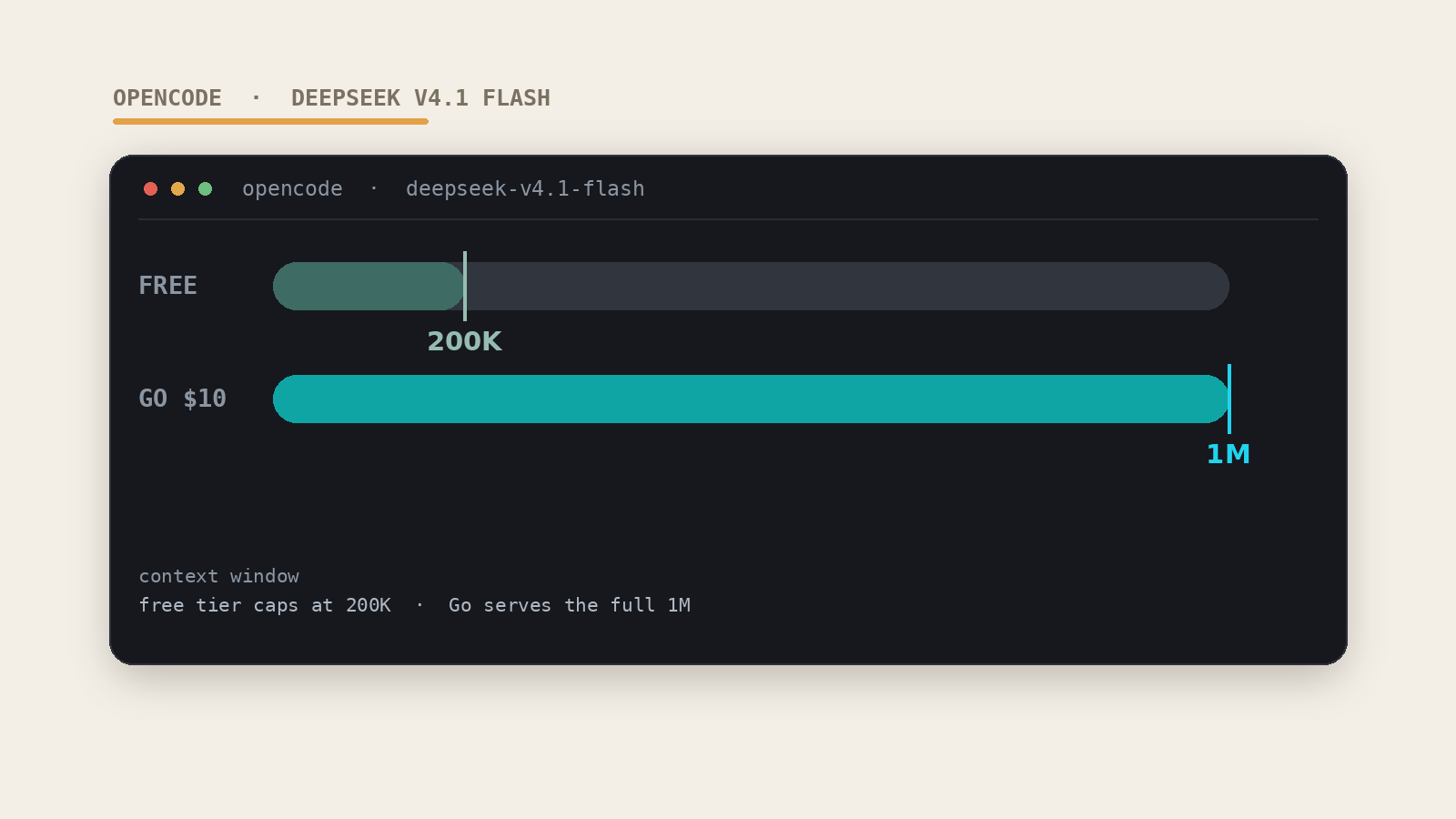
DeepSeek V4.1 Flash costs nothing on OpenCode console and the free model handles most everyday coding work. OpenCode Go costs $10 a month and changes three things: how much context the model holds, how much you can run and where you can run it.
The free model does real work
DeepSeek V4.1 Flash Free runs in OpenCode with a 200,000 token context window and a 32,000 token output limit. Understanding is that the provider keeps your inputs and trains on it. OpenCode lists the model as free for a limited time and the free tier requires the OpenCode client.
What a $10 Go Subscription Adds
| Free | Go ($10/month) | |
|---|---|---|
| Context window | 200,000 tokens | 1,000,000 tokens |
| Output limit | 32,000 tokens | 384,000 tokens |
| Usage | Limited-time free model | $100 a month of DeepSeek usage |
| Clients | OpenCode only | OpenCode, Claude Code, Codex, Hermes, Pi |
The monthly allowance is the difference that matters. Go bills DeepSeek V4.1 Flash at $0.30 per million input tokens and $1.20 per million output tokens at peak, half that off-peak, and stops at $100 of usage. OpenCode estimates that as 43,330 requests every five hours, or about 216,670 a month. Go Plus costs $40 and doubles the DeepSeek allowance to $200.
Context is the other half. Go serves the model with its full million-token window and a 384,000-token output limit. A repository that fits in one window needs no compaction, so the agent keeps the thread of the work.
Where the subscription pays for itself
Two patterns justify the fee. The first is the long session, where a million-token window holds the whole repository and compaction becomes rare. The second is portability: a Go key works in Claude Code, Codex, Hermes, Zeroclaw and Pi so one subscription follows you between agents – the free model does not work with different harnesses.
When you reach the monthly limit, extra Usage falls back to your Console credit instead of stopping the session. The free model has no such fallback.
With deepseek-v4.1-flash-free you will noticed that compare to deepseek-v4.1 from the subscription – it automatically compacts the context more often (when 200k limit is breached) and the detail of the responses is limited (32k output token). The smaller output means it cannot write very large files, might Silently cut-off a response or have broken tool calls. One has to break tasks into smaller chunks to make more effective use of the free model.
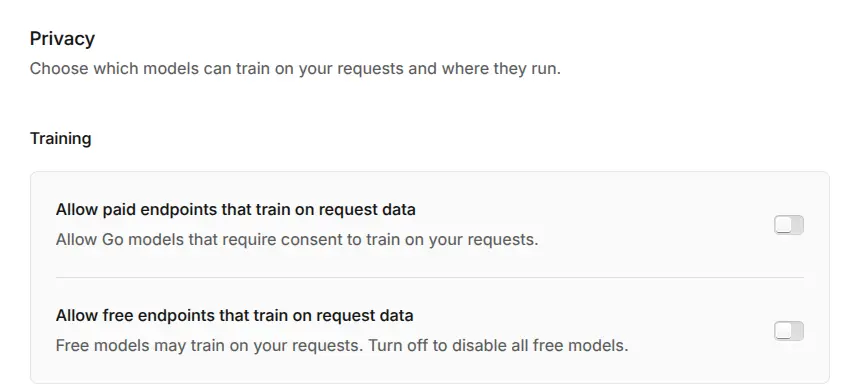
Ensure to review your privacy settings when it comes to allowing models to train with your inputs/data:
If you attempt to use opencode deepseek-v4.1-flash-free from a non-opencode harness like pi…you will get this error:
{"type":"FreeUsageLimitError","message"
:"Free usage limit reached. Free models
work in OpenCode (https://opencode.ai);
subscribe to OpenCode Go to keep going:
https://opencode.ai/go"}
When to stay free
Stay on the free model while you evaluate OpenCode, work on small repositories or send the occasional prompt. Move to Go when you want the whole codebase in context, run more than one agent client, or want a fixed monthly allowance in place of a limited-time free model.
Privacy also decides this one – DeepSeek collects and trains on free model inputs. If you want your inputs to remain private from the provider and not be exposed through training use the Opencode subscription.
For the catalogue and its limits, see OpenCode Go model limits. For a task-level comparison, see comparing OpenCode Go models on a real task.