
TL;DR
Sellers on Yaga keep 100% of their asking price, so the buyer carries the platform’s costs. At checkout you pay three things: the item, the delivery and a Buyer Protection fee that works out to 6.5% of (item + delivery) plus a flat R19.90.
The flat R19.90 plus the delivery charge is the floor. No order escapes it, and then the fee slides up with order value, which hurts small purchases far more than large ones.
Two worked examples, both using a R53 Courier Guy locker:
| Base seller price | Delivery | Buyer Protection fee | You actually pay |
|---|---|---|---|
| R50 | R53.00 | R26.60 | R129.60 |
| R300 | R53.00 | R42.85 | R395.85 |
Read the first row by hand: 6.5% of (R50 + R53) is R6.70, plus R19.90 gives R26.60, and R50 + R53 + R26.60 lands on R129.60. That is the exact total a real Yaga checkout showed for a R50 item. The same formula on a R300 item gives R42.85 and a R395.85 total.
Everything below unpacks that formula, what bundling does to it and what it says about how much money the platform actually makes. All figures come from scanning dozens of live listings across several shops on yaga.co.za and comparing the item price, the delivery price and the final checkout total.
1. The business model, in one paragraph
Yaga never charges the seller to list or to sell. Their own FAQ says it plainly: “Selling on Yaga is completely FREE… you will receive 100% of the asking price to your Yaga Wallet.”
That means every rand Yaga earns has to come from the buyer, from three places:
- The Buyer Protection fee, applied automatically at checkout.
- The delivery fee, which the buyer pays up front and which Yaga settles with the courier. Section 6 finds that Yaga’s delivery rates come in below walk-in retail, so this is unlikely to be a profit line at all.
- The float, which is the interest earned on holding buyer money in escrow until the buyer clicks “Item received”.
The escrow float is real but small and hard to measure from outside, so we will leave it aside and focus on the two fees a buyer actually sees.
2. Decoding the Buyer Protection fee
Yaga’s help centre describes the fee in deliberately vague terms: it “may vary depending on factors such as the applicable order value, the item category, the order type (single item or bundle), and the market.” In other words, they do not publish the actual rate.
You can still work it out. Buy a bank of listings, subtract the item price and the delivery price from the total, and the remainder is the fee. Do that across enough listings and a clean formula falls out.
For single fashion items the fee works out to:
Buyer Protection fee = 6.5% of (item price + delivery) + R19.90
Three examples straight from live listings to prove it:
| Item price | Delivery (Pudo) | Fee charged | Total at checkout |
|---|---|---|---|
| R100 | R64 | R30.56 | R194.56 |
| R200 | R64 | R37.06 | R301.06 |
| R1 000 | R64 | R89.06 | R1 153.06 |
Check the middle row: 6.5% of (200 + 64) is R17.16, plus R19.90 gives R37.06, plus the R200 item, plus R64 delivery lands on R301.06. The formula reproduces the live checkout total to the cent, and it holds across every listing we tested.
The two parts of that formula matter for different reasons. The 6.5% scales with order value, so it protects Yaga on bigger sales. The flat R19.90 is the interesting bit, because it does not scale at all. On a cheap R50 item the fixed fee is almost 40% of the item price. On a R1 000 item its impact is far less significant.
That single design choice tells you a lot about who the platform is built for. It is a marketplace optimised for many small second-hand sales, not a few large ones.
3. What a buyer actually pays to get an item delivered
Here is the table people keep asking for. It takes a range of item prices and shows the true checkout total for each of the common delivery options. Numbers are rounded to the cent and cover the R49 Paxi locker, the R53 Courier Guy locker rate Yaga charges, the standard R64 Pudo locker and the “bundled, free delivery” option. Both of Yaga’s cheaper columns sit below what those couriers charge a walk-in customer, which section 6 comes back to. Pargo typically sits between the Pudo and Paxi prices depending on point and distance.
| Item price | Paxi (R49) | Courier Guy (R53) | Pudo (R64) | Bundled (R0) |
|---|---|---|---|---|
| R50 | R125.34 | R129.60 | R141.31 | R73.15 |
| R100 | R178.59 | R182.85 | R194.56 | R126.40 |
| R150 | R231.84 | R236.10 | R247.81 | R179.65 |
| R200 | R285.09 | R289.35 | R301.06 | R232.90 |
| R300 | R391.59 | R395.85 | R407.56 | R339.40 |
| R500 | R604.59 | R608.85 | R620.56 | R552.40 |
| R750 | R870.84 | R875.10 | R886.81 | R818.65 |
| R1 000 | R1 137.09 | R1 141.35 | R1 153.06 | R1 084.90 |
| R1 500 | R1 669.59 | R1 673.85 | R1 685.56 | R1 617.40 |
| R2 000 | R2 202.09 | R2 206.05 | R2 218.06 | R2 149.90 |
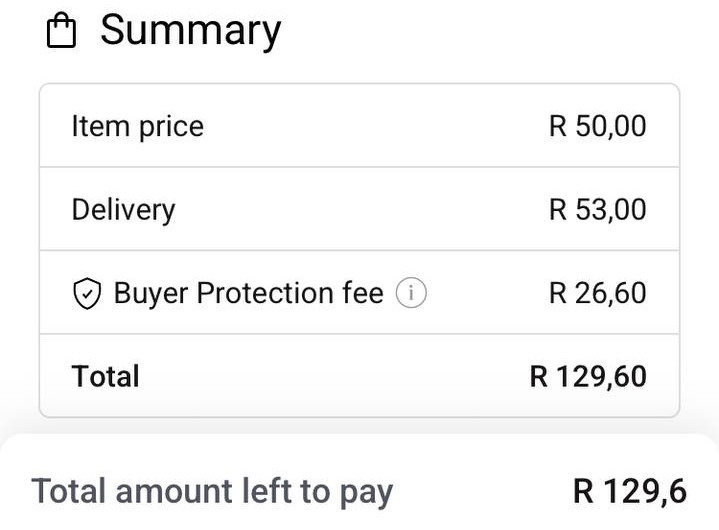
A quick way to read it: to buy a R200 item with a Pudo locker you pay R301. That is R101 on top of the sticker price, of which R64 is courier and R37 is the platform fee. Switch to the Courier Guy locker rate and the same item lands at R289.35, which is the column the screenshot above matches. On a R100 item the add-on is even harsher proportionally, with the fee alone adding over 30% to the item price.
The cost of “getting the item” is never just delivery. It is delivery plus a fee that most buyers do not know exists until they reach the final screen.
4. The bundling trick, and why it matters
If you buy several items from the same seller within an hour, Yaga’s bundling system charges delivery once, for the first item, and treats the rest as free delivery from the same shop. The seller ships everything in one parcel.
This is the single best lever a buyer has, and it is also quietly excellent for Yaga’s margin. Look at what happens to a R200 order:
- One item, Pudo locker: R301.06
- Same item, part of a bundle: R232.90
The buyer saves R68.16, almost all of the courier cost. But notice what Yaga gives up: nothing on the fee side. The platform still collects its 6.5% plus R19.90 on every item in the bundle, and it only pays the courier once for the whole parcel. So bundling consolidates the platform’s biggest variable cost (courier) while its fee revenue scales with the number of items.
The practical buyer tactic follows directly: if a seller has several things you want, add them all inside the one-hour window. Your second item onward loses the courier fee entirely, and the effective fee rate on the combined order drops.
5. Estimating Yaga’s gross margin
Now the interesting part. If we treat the Buyer Protection fee as Yaga’s revenue, we can sketch the gross margin on a typical order. These are estimates with stated assumptions, not Yaga’s accounts.
Worked example, one R200 item shipped by Pudo locker:
| Line | Amount |
|---|---|
| Item price (goes to seller) | R200.00 |
| Delivery (paid to courier) | R64.00 |
| Buyer Protection fee (Yaga revenue) | R37.06 |
| Buyer pays | R301.06 |
Yaga’s gross revenue is the R37.06 fee, roughly 12% of the order value. From that it has to cover:
- Payment processing. Card and instant-EFT gateways in South Africa typically charge around 3% plus R1 to R2. Call it R11 on a R301 order.
- Refunds and disputes. Returned, lost or disputed parcels eat into the fee. Assume a small single-digit slice.
- Support and platform costs. Human support, hosting and the anti-fraud tooling are fixed costs spread across orders.
After payment processing alone, the contribution before overheads is roughly R26 on that order, so around 8% of order value. On a higher-value bundle the fixed R19.90 gets spread thinner, payment processing takes a bigger share, and the percentage margin compresses. On many cheap sales in one parcel the fixed fee does the opposite and margin per parcel climbs.
Why the shape of the fee matters for margin:
- The flat R19.90 guarantees every order clears payment costs even when it is tiny. It is effectively a floor.
- The 6.5% keeps larger baskets worthwhile.
- Bundling removes courier cost from the equation without removing fee revenue, which is why a marketplace that encourages bundling has structurally better margins than one that ships single items.
Put together, a reasonable read is a gross margin somewhere in the high single digits as a share of order value, and a contribution margin on the fee itself of roughly two-thirds to three-quarters after payment costs, before overheads, refunds and support. The business is not high-margin per order. It is high-volume, and the fixed fee plus bundling are what make the unit economics work at small basket sizes.
6. Does Yaga make money on delivery?
The short answer, after checking the published courier rates, is that it looks like it does not. If anything the buyer comes out slightly ahead.
Compare what a walk-in customer pays against what Yaga charges at checkout:
| Service | Walk-in retail | What Yaga charges | Gap |
|---|---|---|---|
| Paxi store-to-store, standard bag, 7 to 9 business days | R59.95 | R49 | -R10.95 |
| The Courier Guy locker-to-locker | ~R59 | R53 | ~-R6 |
Both retail numbers come from the couriers themselves. Paxi publishes R59.95 for a standard store-to-store bag on its 7 to 9 business day service, and The Courier Guy’s locker-to-locker rate sits at about R59. Yaga charges less than both, R49 and R53 respectively.
That is not a rate a walk-in customer can get. It only works if there is a commercial agreement with volume behind it, and Yaga plainly has one. So the likely model is this: Yaga negotiates a wholesale rate, charges the buyer a little under walk-in retail and keeps the difference, or simply absorbs it. Either way it is not a meaningful profit line.
Which flips the earlier suspicion. Delivery is not a hidden margin machine. It is closer to a wash, and possibly a small loss leader that makes the platform feel cheaper than going direct to a courier. The buyer gets a rate they could not get themselves, Yaga gets a smoother checkout, and nobody is getting rich on the R6 or the R11.
The caveat: we cannot see Yaga’s contract, so we cannot say whether the negotiated rate sits below the R49 and R53 they charge, above them, or exactly on them. What we can say is that the consumer-facing numbers are below walk-in retail, which rules out the fat delivery margin some people assume.
7. So what is the business actually worth?
Here is where the units matter. The homepage claim is not “R5 million worth of product sold”. It is 5,013,229 items sold, alongside 1,959,048 users. Read that as cumulative lifetime figures, since Yaga has been running since about 2015. It is a very different number, and it changes the whole estimate.
At an average sale price of R100 to R150 for preloved fashion, five million items works out to roughly R500 million to R750 million of lifetime gross merchandise value. Take a midpoint of R120 and you get about R600 million of product moved through the platform.
Now apply the fee. At an average order of a R120 item plus R60 delivery, the Buyer Protection fee is about R31.60. Multiply by five million orders and lifetime fee revenue lands around R150 million to R160 million. Section 6 found that delivery is charged below walk-in retail, so it adds no margin on top. Call lifetime net revenue roughly R150 million to R160 million, all of it fee.
| Estimate | Low | Mid | High |
|---|---|---|---|
| Average item price | R80 | R120 | R150 |
| Lifetime GMV (5m items) | R400m | R600m | R750m |
| Lifetime fee revenue | R125m | R160m | R200m |
| Annual revenue run-rate | R20m | R30m | R45m |
| Indicative valuation | R40m | R70m | R120m |
The annual figure assumes sales are weighted towards recent years, which is normal for a marketplace that has been compounding. The valuation line applies a small-marketplace multiple of roughly 2 to 4 times revenue, or 8 to 12 times EBITDA at a mature margin. It is a wide band on purpose. Private companies like this do not publish accounts, and a growth story can push the number up while thin profits pull it down.
What that means for the “R500k gross” gut feel: it is off by roughly two orders of magnitude, not because the fee is bigger than we thought, but because the unit was misread. Five million items at about R120 each is not a R5 million business. It is a business that has probably turned over the better part of a billion rand in product and banked well over a hundred million in fees. Modest per order. Serious at scale.
Two caveats to keep in your back pocket. The 1.96 million users are almost certainly cumulative registrations, not active buyers, so do not read them as a monthly audience. And items sold is a lifetime vanity metric that a marketplace has every incentive to keep climbing. The direction of the answer is right. The precision is not.
8. What this means if you buy or sell on Yaga
If you are a buyer:
- Budget the fee, not just the item and delivery. Add roughly 6.5% of (item + delivery) plus R19.90 to any listing to know your true cost.
- Bundle. Buying two or more items from one seller in the same hour removes the courier fee on everything but the first item.
- Cheap items carry a disproportionate fee burden. A R50 item costs between R125 and R141 delivered once delivery and the R26.60 fee are added, nearly three times the sticker price.
If you are a seller:
- You keep 100% of your price, which is genuinely rare and is the platform’s main pull.
- Your buyer’s real cost includes the fee, so a R200 listing feels like R300 to them. Price with that in mind.
- Encouraging buyers to bundle raises your chances of a multi-item sale and makes you look cheaper at checkout.
The bottom line
Yaga does not make money selling. It makes money at checkout, on the buyer’s side, through a Buyer Protection fee that works out to about 6.5% of the item plus delivery, plus a flat R19.90. Delivery, as section 6 showed, is passed through at below-retail rates rather than marked up. The flat component is what makes small second-hand sales viable, and bundling is the mechanism that keeps the courier cost from destroying the margin. Per order the margins are modest. At five million items sold and roughly R600 million of product moved over the platform’s life, they are not modest at all: the fee machine has plausibly banked well over a hundred million rand, even if profit on each order is thin.
Figures derived from live yaga.co.za listings and Yaga’s published help centre articles. The fee formula is inferred from checkout totals, not published by Yaga, and may differ by category or market.