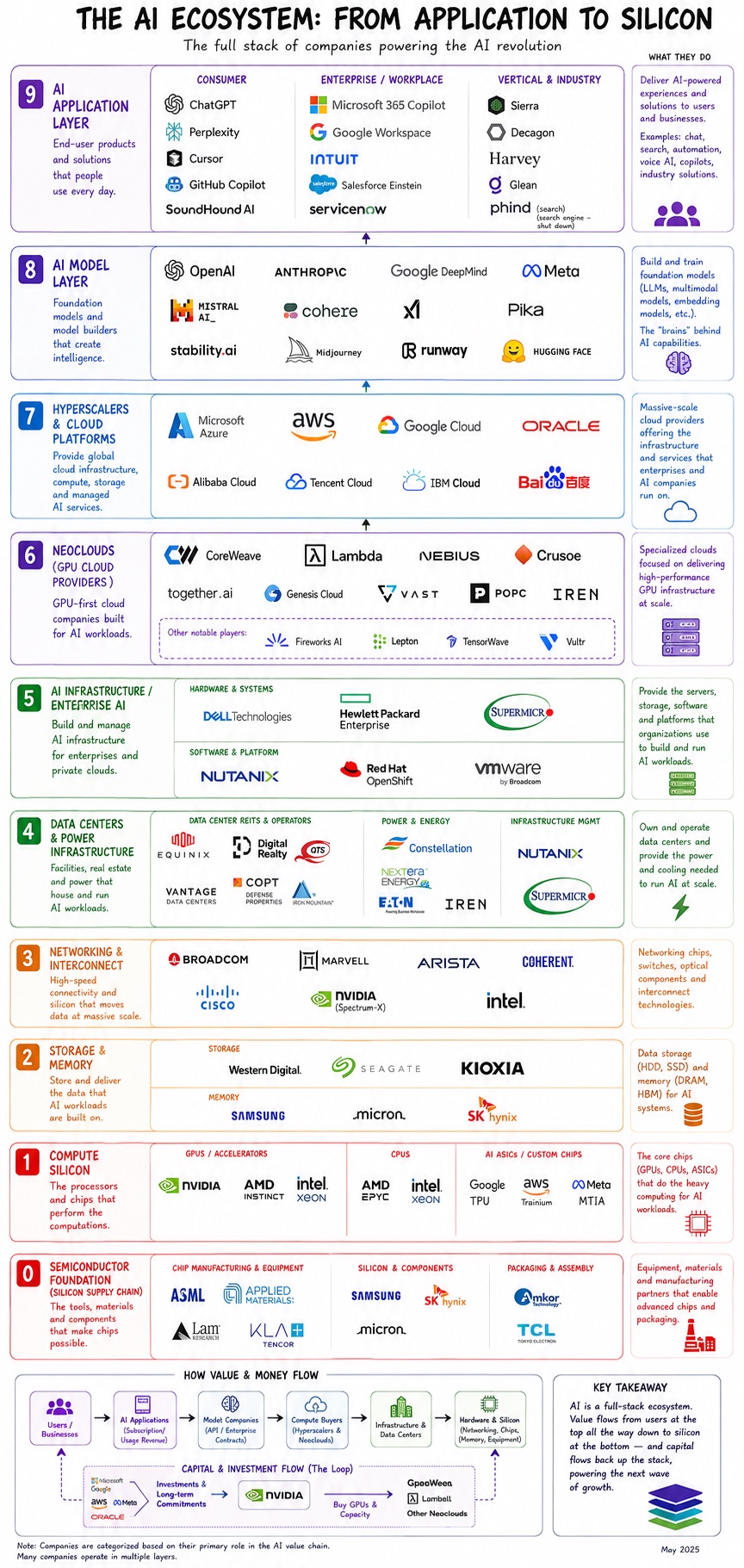
Artificial intelligence has become one of the largest infrastructure build-outs in modern history. Hundreds of billions of dollars are being committed to GPUs, datacentres, networking equipment and power generation to support increasingly capable models.
It is hard to see where any company fits because everything is filed under one label: “AI”. In reality the ecosystem is a stack of layers, each with a different job, a different cost structure and a different kind of risk.
This article maps those layers from the app on your phone down to the lithography machine that prints the chips. The question is where value is created, where capital is spent and where the financial danger lies.
The AI Ecosystem
Application Layer
Where end-user value is created.
Most people only ever touch this layer: asking ChatGPT a question, running Claude in a browser, writing code in Cursor, searching with Perplexity or calling an agent from a terminal.
- General assistants: ChatGPT, Claude and Gemini
- Vertical products: Cursor, Perplexity, Copilot and domain tools in law, support and finance
Some companies own both the application and the model beneath it. The application is still the product and its economics are familiar: seats, subscriptions, usage tiers and distribution.
Every layer below exists because investors expect value to appear here.
Agent Harness Layer
The first layer that actually speaks to the models.
Between the app and the model sits the harness: the software that holds the loop. It assembles the prompt, calls the model, runs the tool, feeds the result back, keeps memory and enforces permissions. In an agentic product, most of the engineering lives here.
Examples: OpenCode (from Anomaly), Claude Code, Codex CLI, the agent mode inside Cursor and self-hosted runtimes such as OpenClaw, Hermes and ZeroClaw.
Two things make this layer matter:
- A small team can build one. Much of the code is open source. OpenCode is the clearest case: an open-source coding agent with no datacentre, no training run and no capex, competing with paid tools on features rather than silicon.
- It decides which model gets called. The harness is the distribution channel for model demand. It can switch provider per task, per price or per policy.
So the harness captures little capital but carries real leverage: it is the switch that routes work to whichever model is cheapest or best that week.
AI Model Layer
Where the intelligence lives.
Model companies train foundation models and sell inference. Both require enormous compute, data and capital.
Frontier labs: OpenAI (GPT), Anthropic (Claude), Google DeepMind (Gemini), Meta (Llama) and xAI (Grok).
Substantial labs outside the US: Mistral, Cohere, DeepSeek and Alibaba (Qwen).
Model categories: large language models, image, video, speech, embedding, recommendation, robotics and scientific models.
LLMs drive the spending. Two shifts define the current phase:
- Open weights compressed the price of competence. Capable open models, many of them Chinese, have pushed the cost of “good enough” reasoning down sharply. Cheap tokens move value up the stack, to the harness and the application.
- Inference is its own business. Serving a model profitably is a different problem from training one, which is why specialist providers (Groq, Together, Fireworks and Cerebras) now sit alongside the labs.
Hyperscaler Layer
The bridge between model companies and the infrastructure stack.
- AWS
- Microsoft Azure
- Google Cloud
- Oracle Cloud Infrastructure
They sell compute, storage, networking and managed services. Historically they hosted websites, SaaS and databases. AI workloads are far more demanding: more GPUs, more power and more capital per rack.
All four are also designing their own silicon: Google TPU, AWS Trainium and Inferentia, Microsoft Maia and Meta MTIA. Each chip is a way out of one vendor’s pricing and supply.
Neocloud Layer
Cloud providers built almost entirely around AI workloads.
- CoreWeave
- Lambda
- Nebius
- Crusoe
Neoclouds appeared because hyperscalers could not supply GPU capacity fast enough and because AI workloads behave differently from web workloads.
They also carry some of the highest financial risk in the stack. Expansion is funded with debt and equity against demand that is hard to forecast, while the hardware underneath loses value quickly.
The risks are structural: heavy upfront capex, fast depreciation, high leverage, thin pricing power and customer concentration.
AI Infrastructure Layer
Builds and integrates the machines.
- Dell
- HPE
- Supermicro
- Nutanix
AI servers, storage systems, networking and integrated racks. Less glamorous than chips but this is where designs become deployable systems.
Datacentre Layer
The physical facilities.
- Equinix
- Digital Realty
- Applied Digital
- QTS
- Vantage
Buildings, power, cooling, physical security and connectivity. The industry is in the middle of one of the largest build-outs in technology history, committing capital before the long-term economics of AI have been proven.
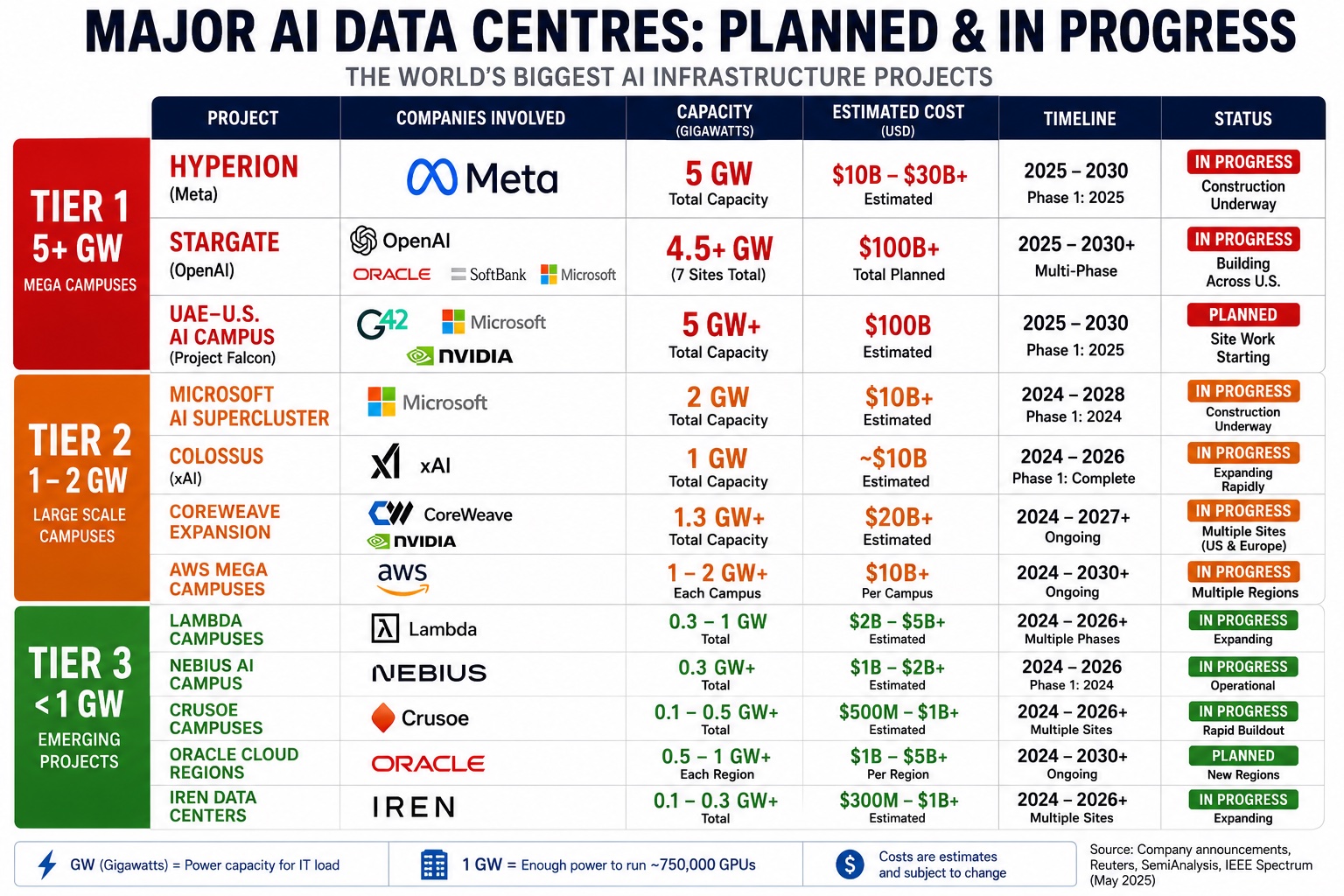
Power Layer
The constraint that now sets the pace.
A datacentre is a power contract with a building attached. The binding limit is no longer chips but megawatts: turbines, grid interconnection, transformers and long-term supply agreements.
- Generation and trading: Constellation and Vistra
- Equipment: GE Vernova and Siemens Energy
- Plus grid operators, utilities and the interconnection queue
Time-to-power, not time-to-silicon, is what delays a campus. That is why so much of the current deal-making is about electricity rather than compute.
The Physical Layer
The hardware that powers every request. Without it, models cannot be trained and applications cannot run.
Networking
Moves data between GPUs, servers and datacentres.
- Arista
- Broadcom
- Marvell
- Cisco
- HPE (Juniper)
Training runs use tens of thousands of accelerators working as one machine. Networking decides how much of that capacity is actually usable.
Storage
Holds training data, model weights and user data.
- Seagate
- Western Digital
- Pure Storage
Cheaper and quieter than compute, but a shared bottleneck when thousands of accelerators read the same dataset.
Compute & Memory
Does the arithmetic.
- Accelerators: Nvidia, AMD and Intel
- High-bandwidth memory: SK Hynix, Micron and Samsung
- Purpose-built: Google TPU, AWS Trainium and Cerebras WSE
Nvidia is the face of AI demand, but the memory stacked beside the chip is just as critical. Most models hit a memory bandwidth limit before a compute limit, which is why HBM supply is a strategic chokepoint.
AWS Trainium follows the same idea as the TPU: a custom accelerator built for one cloud’s own workloads.
Two designs answer that bottleneck differently:
- Google TPU is a systolic array built for matrix maths and wired into large pods. Scale out across many chips.
- Cerebras WSE is a wafer-scale engine: the whole wafer is one chip and model weights sit in on-chip memory instead of external HBM. That removes most of the memory and networking traffic between GPUs and buys very low latency per token. The trade-offs are capacity per dollar, power delivery and cooling, plus a model that has to fit on one wafer.
One scales out, the other scales up. Both exist because moving data costs more than computing on it.
Semiconductor Foundations
Design and manufacture the hardware that everything above depends on.
Foundries
- TSMC
- Samsung Foundry
- Intel Foundry
Semiconductor Equipment
- ASML
- Applied Materials
- Lam Research
- KLA
This is the deepest moat in the stack. Foundries such as TSMC buy their EUV lithography machines from ASML, the sole supplier. EUV light prints the finest features on leading-edge chips, so every advanced accelerator in this article depends on those machines. Foundry capacity takes years and billions to add, so this layer sets the tempo for everything above it.
The Central Question
Every layer depends on demand from the top.
Applications → Models → Create demand → Require compute → Justify infrastructure
There is a complication. A meaningful share of today’s demand is financed from inside the stack: chip vendors taking stakes in the labs that buy their chips, clouds leasing capacity back to the same customers and suppliers guaranteeing each other’s revenue.
That does not make the demand fake. It makes the cycle self-referential and harder to read from the outside: revenue at the top is partly funded by capital from the bottom.
If applications create enough value, the spending is justified. If they do not, a great deal of capital has been committed to assets that cannot earn a return.
Why AI Is Different From SaaS
Software margins are high because serving one more customer costs almost nothing.
AI is not like that. Every prompt, image and agent step consumes compute. Inference burns GPUs, memory, networking and electricity. That is only the running cost. Above it sit training runs, research and capacity commitments.
This is the core difference: SaaS sells copies; AI sells work. Work has a marginal cost. It does not fall to zero because the software already exists.
Bringing It All Together
Applications
↓
Agent harnesses
↓
Models and inference
↓
Hyperscalers and neoclouds
↓
Infrastructure and datacentres
↓
Power
↓
Networking, compute and memory
↓
Semiconductor foundations
Value flows down from the application. Capital flows up from the physical layer.
The question is not whether AI will matter. It is whether the value created at the top will justify the build-out beneath it.
Looking Ahead
Hundreds of billions are being committed before the returns are proven. Whether those investments earn an adequate return is one of the most important open questions in technology.
Future articles will examine:
- The financial performance of AI companies
- Inference economics
- Margins and profitability
- Datacentre and power economics
- Risks in the current build-out
- Winners and losers across the stack